Hurricane Katrina
"We lost everything. Katrina didn't care if you were poor or rich; all the houses look the same now."
- Mississippi resident Penny Dean
(Farris).
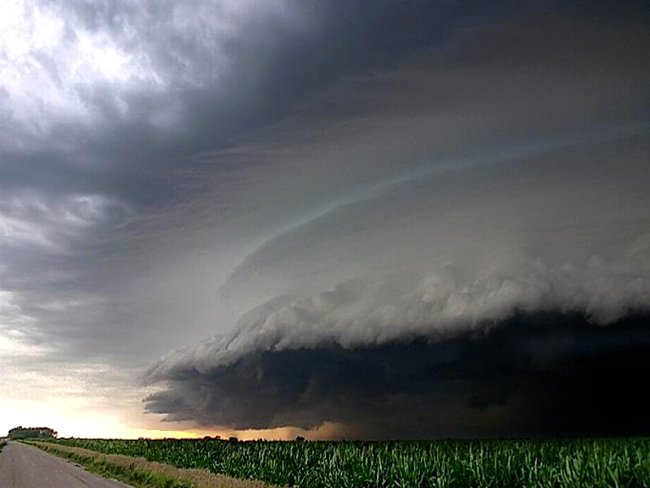
(Operation).
| Contents |
| 1 Migration of People |
| 2. Effects |
| 3. Damage |
| 4. Hurricane Scale |
| 5. Bibliography |
1. Migration of People
Refugees were brought to the Superdome, one of the largest buildings in the city, to wait out the storm and for further evacuation. Many others made their way to the Superdome on their own in search of food, water, shelter, or transport out of town. On August 29, Katrina dominated New Orleans with such force that it ripped two holes in the Superdome roof. On the evening of August 30, Major General Bennett C. Landreneau, of the Louisiana National Guard, said that the number of people taking shelter in the Superdome had risen to around 15,000 to 20,000 as search and rescue teams brought more people to the Superdome from areas hard-hit by the flooding. As the water continued to rise and the horrible conditions grew, on August 31, Governor Blanco ordered that all of New Orleans, including the Superdome, be evacuated. The area outside the Superdome was flooded to a depth of three feet, with a possibility of seven feet if the area equalized with Lake Pontchartrain. Governor Blanco had the state send in 68 school buses on Monday to begin evacuating people (Knabb).

(Operation).
"In anticipation of widespread destruction caused by Hurricane Katrina, Max Mayfield, the director of the National Hurricane Center, telephoned New Orleans Mayor Ray Nagin on the night of August 27 to express his extreme concern, and on the following day, made a video call to U.S. President George W. Bush at his farm in Crawford, Texas about the severity of the storm" (Fairris).
With the hurricane threatening the Gulf Coast, many New Orleans residents started taking precautions to secure their homes and prepare for possible evacuation on Friday the 26th and Saturday the 27th. By mid morning on the 27th, many local gas stations which were not yet out of gas had long lines. Nagin first called for a voluntary evacuation of the city at 5:00 p.m. on August 27 and subsequently ordered a citywide mandatory evacuation at 9:30 a.m. on August 28, the first such order in the city's history. In a live news conference, Mayor Nagin predicted that, "the storm surge most likely will topple our levee system", and warned that oil production in the Gulf of Mexico would be shut down. President Bush made a televised appeal for residents to heed the evacuation orders, warning, "We cannot stress enough the danger this hurricane poses to Gulf Coast communities." Many neighboring areas and parishes also called for evacuations. By mid-afternoon, officials in Plaquemines, St. Bernard, St. Charles, Lafourche, Terrebonne, Jefferson, St. Tammany, and Washington parishes had called for voluntary or mandatory evacuations" (Farris).
2. Effects
The massive flooding stranded many people, who stayed long after Hurricane Katrina had passed. Stranded survivors dotted the rooftops throughout the whole city. Some were trapped inside and could not escape. Many people broke through to the top of their roof with various tools. Residents had been urged to stay in their attics in case of such events. There was no clean water, and power outages were expected to remain for weeks to come (Farris).

(Laue).
3. Damage
The damages on the environment and threat to public health were the longest lasting effects of hurricane Katrina. The oil spills, indusrial wastes, toxic chemicals, household sewage, and other hazardous pollutants swept to the directly hit areas and neighboring regions. The contaminated floodwater overflowed the residential areas and caused long-term health effects on people, animals and other inhabitants in the area. It also resulted in pollution of groundwater reserves, which is a major water source for drinking purposes (Schmaltz).
| Rank | Hurricane | Season | Cost (2008 USD) |
|---|---|---|---|
| 1 | Katrina | 2005 | $89.6 billion |
| 2 | Andrew | 1992 | $40.7 billion |
| 3 | Ike | 2008 | $24.0 billion |
| 4 | Wilma | 2005 | $22.7 billion |
| 5 | Charley | 2004 | $18.6 billion |
| Main article: List of costliest Atlantic hurricanes | |||
 (Laue)
At least 1,836 people lost their lives in the actual hurricane and in the subsequent floods, making it the deadliest U.S. hurricane since the 1928 Okeechobee hurricane. Economist and crisis consultant Randall Bell wrote: "Hurricane Katrina in 2005 was the largest natural disaster in the history of the United States. Preliminary damage estimates were well in excess of $100 billion, eclipsing many times the damage wrought by Hurricane Andrew in 1992" (McQuaid).
The levee failures prompted investigations of their design and construction which belongs to the USACE as mandated in theFlood Control Act of 1965 and into their maintenance by the local Levee Boards (who prevented the Army Corps from building flood gates at the mouth of the drainage canals at Lake Pontchartrain). There was also an investigation of the responses from federal, state and local governments, resulting in the resignation of FEMA director Michael D. Brown, and of NOPD Superintendent Eddie Compass. Conversely, the USCG, NHC and NWS were widely commended for their actions, accurate forecasts and abundant lead time (McQuaid).
4. Hurricane Scale
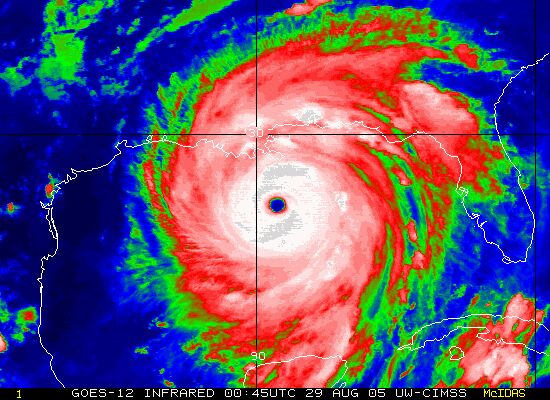
(Schmaltz).
Hurricane Katrina formed over the Bahamas on August 23, 2005 and crossed southern Florida as a moderate Category 1 hurricane, causing some deaths and flooding there before strengthening rapidly in the Gulf of Mexico. The storm weakened before making its second landfall as a Category 3 storm on the morning of Monday, August 29 in southeast Louisiana. It caused severe destruction along the Gulf coast from central Florida to Texas, much of it due to the storm surge. The most severe loss of life and property damage occurred in New Orleans, Louisiana, which flooded as the levee system catastrophically failed, in many cases hours after the storm had moved inland. Eventually 80% of the city became flooded and also large tracts of neighboring parishes, and the floodwaters lingered for weeks (Knabb).

(Operation).
The storm rapidly intensified after entering the Gulf, growing from a Category 3 hurricane to a Category 5 hurricane in just nine hours. This rapid growth was due to the storm's movement over the "unusually warm" waters of the Loop Current, which increased wind speeds. On Saturday, August 27, the storm reached Category 3 intensity on the Saffir-Simpson Hurricane Scale, becoming the third major hurricane of the season. An eyewall replacement cycle disrupted the intensification, but caused the storm to nearly double in size. Katrina again rapidly intensified, attaining Category 5 status on the morning of August 28 and reached its peak strength at 1:00 p.m. CDT that day, with maximum sustained winds of 175 mph (280 km/h) and a minimum central pressure of 902 mbar. The pressure measurement made Katrina the fourth most intense Atlantic hurricane on record at the time, only to be surpassed by Hurricanes Rita and Wilma later in the season; it was also the strongest hurricane ever recorded in the Gulf of Mexico at the time (a record also later broken by Rita). (McQuiad).
(Schmaltz).
S5. Bibliography
Farris, Gaye. "National Wetlands Research Center". usgs. 12 November 2009 < http://www.nwrc.usgs.gov/releases/pr06_002.htm >.
Schmaltz, Jeff. "Hurricane Katrina (12L) approaching the Gulf Coast". NASA. 12 November 2009 < http://visibleearth.nasa.gov/view_rec.php?id=7938 >.
Laue , Kevin. "Hurricane Season". Dutchman Films. 12 November 2009 < http://www.dutchmenfilms.com/InDevelopment.htm >.
"Operation Hurricane Katrina Relief". Week in Photos. 12 November 2009 < http://www.af.mil/weekinphotos/050909-04.html >.
McQuiad, John. "Human Error Blamed for Making New Orleans' Flooding Worse". Newshouse News Service. 12 November 2009 < http://www.levees.org/research/sources/Newhouse%20A1.htm >.
Knabb, Richard. "Tropical Cyclone Report". National Hurricane Center. 12 November 2009 < http://www.nhc.noaa.gov/pdf/TCR-AL122005_Katrina.pdf >.
